
Choosing between an AC vs DC coupled battery system is one of the most critical decisions when designing a domestic solar installation in the UK. Whether you are installing solar panels for the first time or looking to retrofit energy storage to an existing array, understanding how energy flows from your roof into your home and battery will determine your overall efficiency, equipment costs, and flexibility.
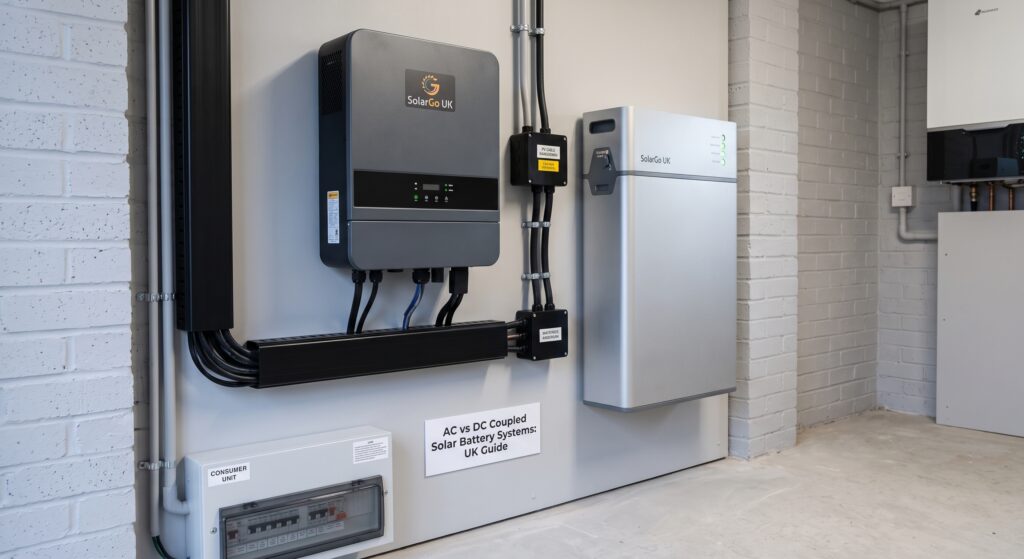
In this comprehensive guide, we compare AC and DC battery coupling architectures, round-trip efficiency, inverter considerations, and how they pair with popular UK time-of-use tariffs.
What Does Battery Coupling Mean?
Solar panels generate Direct Current (DC) electricity, while domestic UK appliances and the National Grid run on Alternating Current (AC). A solar battery stores electricity in DC format.
The distinction between AC and DC coupling lies entirely in where and how many times electricity converts between AC and DC before being used in your household or stored in the battery pack.
What is a DC Coupled Solar Battery System?
In a DC coupled architecture (often referred to as a hybrid inverter system), the solar panels and the battery share a single, central inverter.
How Power Flows in a DC System:
- Solar to Battery: DC power from the solar panels travels straight to the battery without any conversion.
- Battery to Home: When household demand peaks, the stored DC power is converted once by the hybrid inverter into AC for home appliances.
- Efficiency: Because generation bypasses an initial DC-to-AC conversion cycle, DC coupled systems boast high round-trip efficiency, typically around 94% to 97%.
Key Advantages of DC Coupling:
- Higher Solar Charging Efficiency: No conversion losses when storing daytime solar generation directly into the battery cells.
- Single Inverter Footprint: Only one piece of hardware is mounted on your wall, saving valuable space in garages or utility rooms.
- Cost Effective for New Builds: Lower initial hardware costs when installed alongside a brand-new solar PV array.
What is an AC Coupled Solar Battery System?
In an AC coupled system, the solar panels and the battery operate via completely independent inverters.
The solar PV array uses a dedicated standard string or micro-inverter to convert solar generation into AC power. Meanwhile, the battery has its own built-in bidirectional inverter connected directly to your home’s AC consumer unit. Prominent examples of AC coupled batteries in the UK include the Tesla Powerwall and GivEnergy AC 3.0.
How Power Flows in an AC System:
- Solar to Inverter: DC solar energy converts to AC power via the solar inverter.
- Home to Battery: Surplus AC electricity travels to the battery’s dedicated inverter, where it is converted back into DC for storage.
- Battery to Home: When the home needs power, the battery inverts the DC electricity back into AC for the second time (triple-conversion path).
Key Advantages of AC Coupling:
- The Ultimate Retrofit Solution: You can add an AC battery to any pre-existing solar PV array without altering your existing inverter or touching MCS-certified warranties.
- Independent Inverter Sizing: If you already max out your generation capacity under UK DNO Approval, AC battery charging directly from off-peak grid tariffs operates independently.
- Redundancy & Reliability: If the solar inverter encounters a fault, the battery remains functional to charge from off-peak rates and power your home.
AC vs DC Coupled: Direct Comparison
| Feature | DC Coupled (Hybrid Inverter) | AC Coupled (Separate Inverter) |
|---|---|---|
| Best Suited For | New solar + battery installations | Existing solar retrofits |
| Round-Trip Efficiency | High (Approx. 95%+) | Moderate (Approx. 88% – 92%) |
| Inverter Setup | 1 Hybrid Inverter | 2 Separate Inverters |
| Installation Flexibility | Must be close to solar inverter | Can be installed anywhere near consumer unit |
| DNO Application | Single combined rating | Dual asset notification required |
Impact on UK Off-Peak Tariffs (Octopus Flux and Agile)
Many UK households charge their domestic storage overnight using cheap off-peak rates from providers like Octopus Energy and discharge during expensive peak evening hours. When weighing an AC vs DC coupled setup for smart tariff switching, the charging mechanics differ slightly:
- Grid-to-Battery Efficiency: When charging directly from the grid overnight, an AC vs DC coupled comparison shows near-identical performance. Both architectures must convert incoming AC electricity from the grid into DC power for storage inside the battery.
- Peak Discharge Output: In an AC vs DC coupled configuration, battery discharge capabilities vary. An AC-coupled battery can discharge through its own inverter while your solar panels export through another, whereas a DC-coupled hybrid inverter shares a single power ceiling.
- Software Integration: Leading UK smart tariffs, especially dynamic export tariffs, integrate smoothly regardless of whether you choose an AC vs DC coupled layout, provided your battery system includes smart automated scheduling.
For further regulatory standards and installation requirements across UK domestic storage networks, consult the technical guidance provided by the Energy Saving Trust.
Which System Should You Choose?
- Choose a DC Coupled System if: You are installing solar panels and battery storage at the same time from scratch. You will benefit from lower hardware costs, less cabling, and higher solar capture efficiency.
- Choose an AC Coupled System if: You already have solar panels installed under a feed-in tariff (FIT) or legacy contract, or you plan to start with an energy storage system to take advantage of cheap overnight electricity tariffs before adding solar later.
Planning your setup? Check our Solar Sizing & Payback Guide to calculate realistic returns for your home.
When deciding between an AC vs DC coupled system, evaluate whether you value retrofitting simplicity or all-in-one charging efficiency.