
Enrolling in the Smart Export Guarantee (SEG) is the most effective way for UK homeowners to monetize surplus electricity produced by rooftop solar panels and battery storage. Introduced by the UK government to succeed the legacy Feed-in Tariff (FIT), the SEG scheme legally requires licensed energy suppliers to pay microgenerators for every kilowatt-hour (kWh) of renewable electricity exported back to the National Grid.
Whether you operate a modest 3.68 kW rooftop system or a high-capacity hybrid solar array paired with battery storage, understanding how export tariffs function will significantly shorten your system payback timeline.
What is the Smart Export Guarantee (SEG)?
The Smart Export Guarantee is a government-backed initiative overseen by the UK energy regulator, Ofgem. Under this regulation, all licensed electricity suppliers with more than 150,000 domestic customers must offer at least one export tariff to small-scale generators.
Unlike the historic Feed-in Tariff, which paid an estimated 50% deemed export rate regardless of actual grid injection, the SEG demands half-hourly metered data. You are paid exclusively for the exact units of electricity your home physically sends to the network.
Eligibility Criteria for UK Homeowners
To qualify for a Smart Export Guarantee tariff, your installation must satisfy four core compliance requirements:
- MCS Certification: Your solar PV panels and inverter must be installed by an installer accredited under the Microgeneration Certification Scheme (MCS), or an equivalent recognized standard.
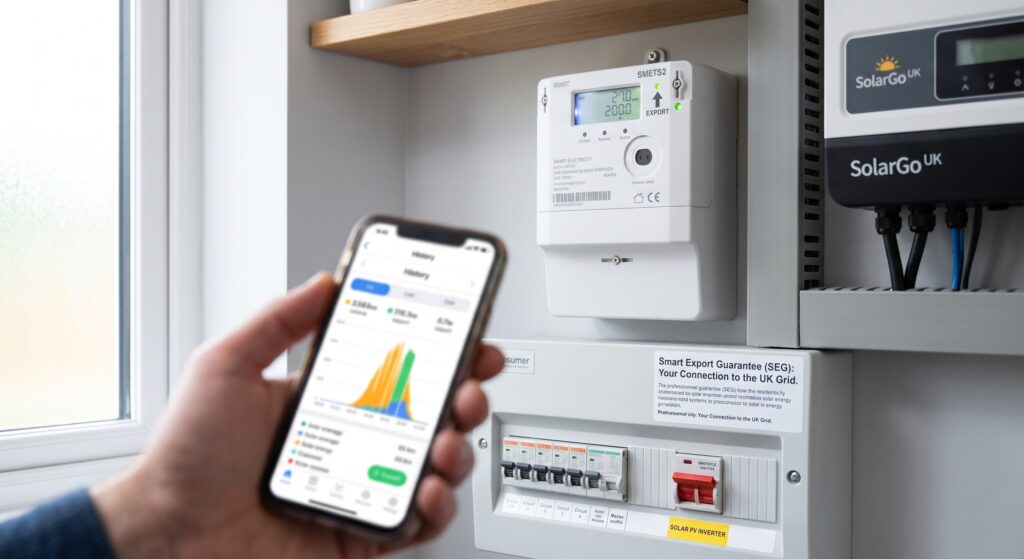
- SMETS2 Smart Meter: Your property must have a functioning second-generation smart meter (SMETS2) or an operational SMETS1 meter capable of recording export readings at 30-minute intervals.
- Capacity Threshold: The total installed generation capacity must not exceed 5 MW (or 50 kW for micro-combined heat and power setups).
- DNO Confirmation: You must hold a formal connection acceptance letter under G98 or G99 DNO approval from your regional Distribution Network Operator.
Fixed vs Dynamic SEG Tariffs: Which Pays More?
Energy suppliers design their own export payment packages, which broadly fall into two main structures:
1. Fixed Export Tariffs
A fixed tariff pays a consistent, unvarying pence-per-kWh rate throughout the day and year, irrespective of wholesale market volatility. Standard baseline rates typically range between 3p and 5p/kWh, though competitive tariffs from select suppliers reach 15p/kWh for loyal or bundled customers.
2. Dynamic & Time-of-Use Export Tariffs
Dynamic export tariffs fluctuate depending on grid wholesale demand. Leading providers such as Octopus Energy offer agile and variable rates (e.g., Octopus Outgoing or Octopus Flux) that reward homeowners substantially higher returns—frequently exceeding 20p to 30p/kWh—when exporting stored power during the 4 PM to 7 PM peak national grid demand window.
Comparison of Leading UK SEG Providers
| Energy Supplier | Tariff Name | Standard Export Rate (p/kWh) | Special Requirements |
|---|---|---|---|
| Octopus Energy | Outgoing Fixed | 15.0p | Requires smart meter & Octopus import |
| Octopus Energy | Agile / Flux | Dynamic peak rates (up to 25p+) | Requires home battery system |
| OVO Energy | OVO Solar Boost | Up to 15.0p | Requires OVO domestic import tariff |
| British Gas | Export & Earn Plus | 15.0p | Requires British Gas import account |
| E.ON Next | Next Export Exclusive | Up to 16.5p | Existing E.ON Next dual-fuel customer |
| Standard Baseline | Open Market Minimum | 2p – 4.5p | Available without switching your import supplier |
Note: Rates vary based on underlying market wholesale prices and customer loyalty agreements.
Maximizing Earnings: Pairing Solar with Battery Storage
Installing battery storage introduces a lucrative dimension to your Smart Export Guarantee returns:
- Tariff Arbitrage: When your system is configured with an AC or DC coupled battery, you can charge the battery during off-peak night hours at low cost (e.g., 7p/kWh) and export excess stored energy during peak evening windows at up to 25p/kWh.
- Self-Consumption vs Exporting: Because domestic import electricity typically costs between 24p and 29p/kWh, self-consuming your solar energy always saves more money than exporting at low baseline rates. Exporting is best reserved for true summer surpluses or dynamic peak tariff discharge.
Step-by-Step Guide to Applying for SEG
- Obtain Your MCS Certificate: Ensure your installer hands over your MCS certificate and DNO notification paperwork upon commissioning.
- Verify Your Export MPAN: Contact your electricity supplier to register an Export MPAN (Meter Point Administration Number). This is a distinct identifier tied to your smart meter’s outbound channel.
- Compare Tariffs: You do not have to sell your power to the same supplier you buy electricity from; however, suppliers reserve their most generous rates for dual-fuel or bundled import customers.
- Submit Application: Complete the online SEG registration form with your chosen supplier, attaching your MCS certificate and proof of ownership.
- Receive Payments: Payments are settled periodically via direct bank transfer or credited against your monthly domestic energy statement.
Curious about how much you can earn annually from solar export? Explore our Solar ROI & Savings Calculator to test different tariff scenarios for your roof.