
Choosing the correct capacity for your home energy storage is the difference between achieving true energy independence and overpaying thousands on redundant hardware. In this comprehensive solar battery sizing guide, we break down how to accurately determine the exact kilowatt-hour (kWh) capacity your UK home needs to maximise daytime solar capture and leverage overnight off-peak smart tariffs.
Whether you live in a modest terraced house or a detached property with a heat pump and electric vehicle (EV), sizing a solar battery requires balancing daily electricity consumption, solar array yield, and peak discharge demands.
Why Getting Your Battery Sizing Right Matters
Oversizing or undersizing your domestic battery storage carries distinct financial consequences:
Following an accurate solar battery sizing guide ensures you do not waste money on excess capacity or suffer from unmet evening demand.
- The Cost of Oversizing: A battery that never drops below 40% state-of-charge during winter or never fills during overcast days represents stranded capital that prolongs your payback period.
- The Drawback of Undersizing: A system that drains before peak evening rates conclude forces your household to pull expensive electricity from the grid at peak daytime prices (24p–29p/kWh).
- The Sweet Spot: A properly sized battery charges to 100% during sunny summer afternoons (or overnight on off-peak rates) and covers your household baseline consumption until the next generation cycle.
Key Metrics to Understand: Nominal vs Usable Capacity
When reviewing manufacturer datasheets, you will encounter two capacity specifications:
- Nominal (Total) Capacity: The total physical volume of electricity the lithium-iron-phosphate (LFP) cells can store.
- Usable Capacity (Depth of Discharge – DoD): The actual percentage of stored energy your battery management system (BMS) allows you to discharge.
To prolong cell lifespan, most tier-one manufacturers set an 80% to 90% Depth of Discharge. When following this solar battery sizing guide, always base your calculations on usable kWh rather than nominal capacity.
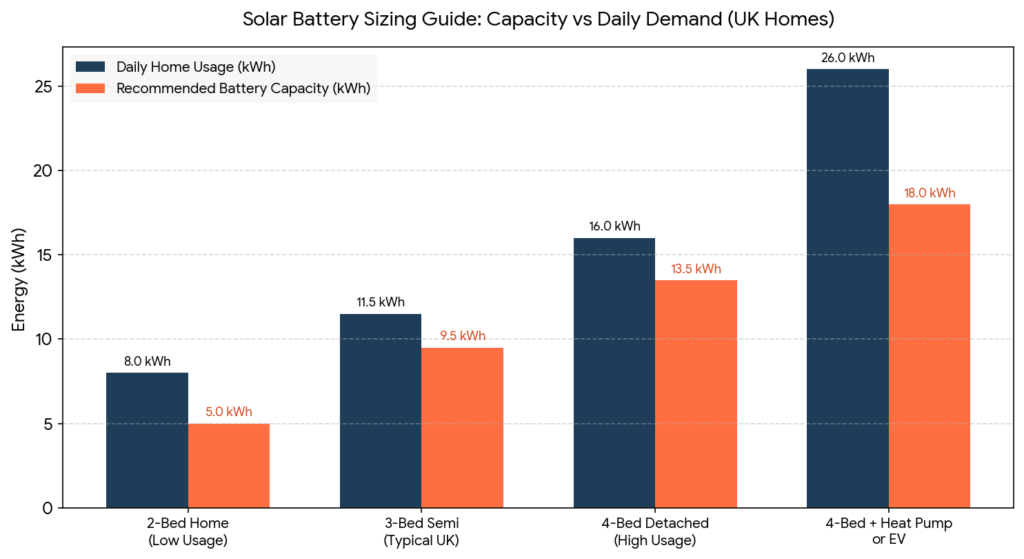
Recommended Battery Sizes for UK Households
Domestic energy consumption varies significantly depending on heating sources and vehicle charging. The table below outlines standard benchmarks across the UK:
| Property Type | Typical Daily Usage | Solar Array Size | Recommended Usable Battery |
|---|---|---|---|
| 1-2 Bed Flat / House | 6 – 8 kWh | 2.5 – 3.5 kWp | 3.5 – 5.2 kWh |
| 3-Bed Semi-Detached | 10 – 13 kWh | 4.0 – 5.0 kWp | 8.0 – 10.0 kWh |
| 4-Bed Detached | 14 – 18 kWh | 6.0 – 8.0 kWp | 10.5 – 14.0 kWh |
| Home with Heat Pump / EV | 22 – 30+ kWh | 7.0 – 10.0+ kWp | 15.0 – 20.0+ kWh |
Factors That Influence Your Sizing Calculation
1. Evening Baseline Consumption (The 4 PM to 10 PM Window)
Calculate how much electricity your home consumes after the sun sets. For most working households, 50% to 65% of total daily energy is consumed between 4:00 PM and bedtime. Your battery should, at minimum, cover this critical window.
2. Coupling Architecture: AC vs DC
Your choice of inverter architecture influences usable efficiency:
- In a DC coupled hybrid inverter system, round-trip solar charging efficiency reaches 95%+, meaning less lost energy during charging.
- An AC-coupled system offers flexible modular stacking if you plan to start small and expand capacity in future years.
3. Smart Tariffs & Winter Grid Charging
UK winters produce only 15% to 20% of the solar generation seen in peak summer months. To keep your battery working all year, most homeowners switch to dynamic tariffs like Octopus Flux or Agile. In winter, you fill your battery overnight at cheap off-peak rates (e.g. 7p/kWh) and discharge during expensive daytime windows. A larger battery (10 kWh+) makes winter tariff arbitrage significantly more profitable.
4. DNO Export and Inverter Limits
Before installing a high-capacity battery system, ensure your electrical installer checks the regional UK DNO G98 / G99 approval guidelines. High-power battery inverters discharging more than 3.68 kW on single-phase connections require prior network operator consent.
How to Calculate Your Ideal Size in 3 Steps
- Check Your Annual Consumption: Check your annual electricity statement (in kWh) and divide by 365 to determine your average daily consumption.
- Isolate Evening Usage: Multiply your daily consumption by 0.60 (60%) to establish your non-solar evening demand.
- Add Tariff Buffer: If you plan to charge exclusively from off-peak grid power in winter, choose a usable battery size equal to approximately 80% to 100% of your total daily consumption.
For independent official guidance on storage performance and MCS installation standards, visit the Energy Saving Trust Battery Advice.
Financial Incentives: 0% VAT on Batteries
Remember that whether you fit your energy storage alongside new solar panels or retrofit a standalone unit to an existing array, domestic batteries currently benefit from the UK solar panel VAT exemption at 0% VAT until March 2027.
Use this solar battery sizing guide alongside your actual winter and summer smart meter export records to calibrate exact capacity.
Ready to design your setup? Use our Solar & Storage ROI Calculator to model custom payback timelines for your property.